
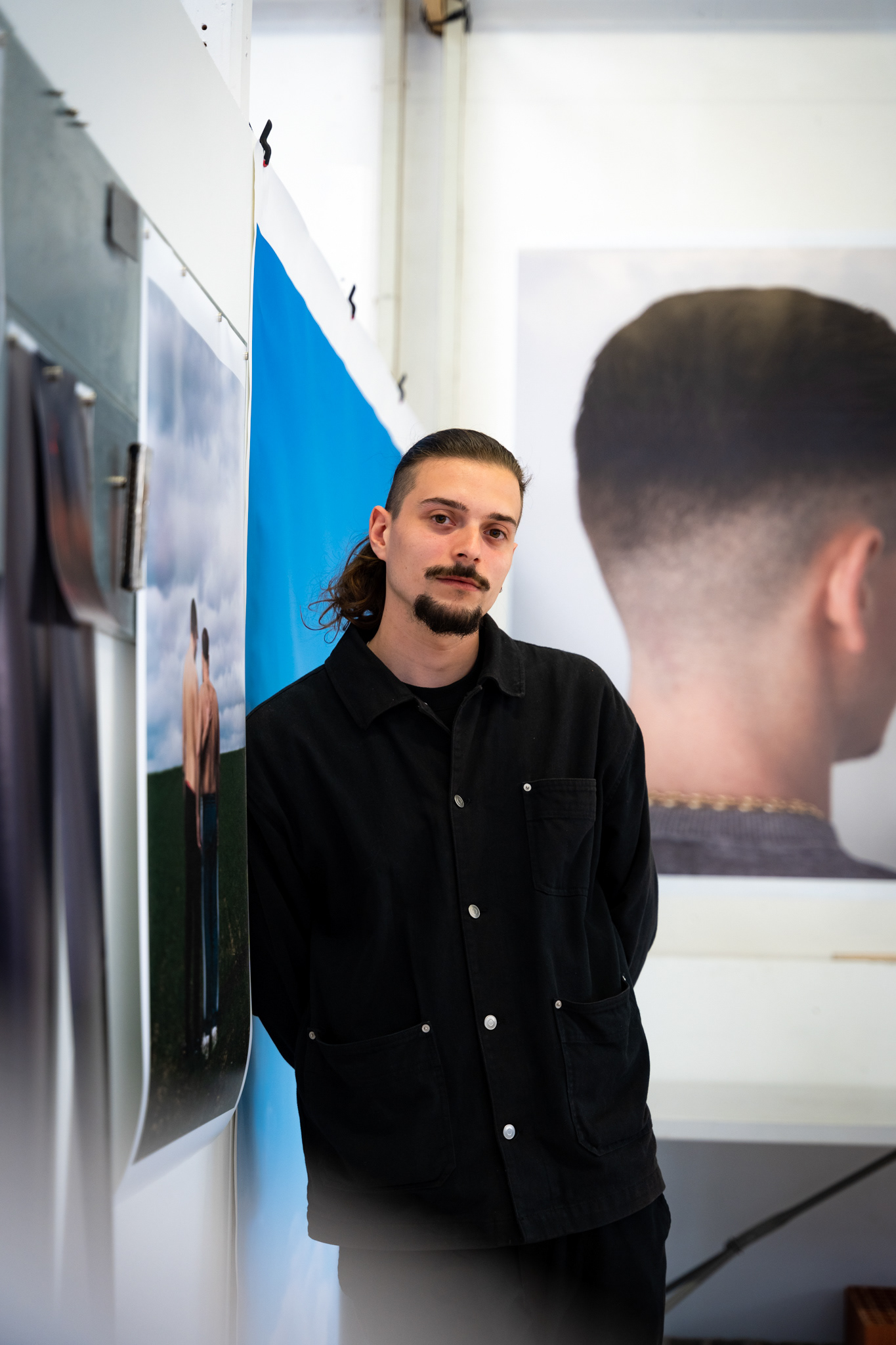
Photographie : Lucie Pochet
Matteo Pereira (né en 2002 à Reims) est diplômé de l’École Supérieure d’Art et de Design de Reims en 2025 avec les félicitations du jury. Il vit et travaille entre Reims, la campagne qui l’entourent et le nord du Portugal. Sa pratique se construit à partir de récits situés, liés aux territoires, aux héritages familiaux et aux formes de transmission qui façonnent les individus. À travers la photographie, la vidéo et l’installation, il explore la manière dont les corps, les gestes et les espaces participent à construire une identité. Son travail s’intéresse aux récits invisibilisés, aux liens entre mémoire intime et histoire collective, ainsi qu’aux tensions
entre appartenance, déplacement et transformation.
entre appartenance, déplacement et transformation.
Issu d’un territoire rural Matteo Pereira développe une recherche autour des représentations des espaces périphériques et des expériences qui s’y construisent.
Les relations d’amitié, les gestes hérités du monde du travail, les récits familiaux et les formes de masculinité qui émergent dans ces territoires constituent des éléments centraux de sa démarche. Par l’utilisation d’images réalisées avec ses proches, de matériaux issus de l’industrie et d’objets du quotidien, il cherche à faire apparaître des histoires qui restent souvent en dehors des représentations culturelles dominantes.
Son travail se caractérise par une attention portée aux traces laissées par les corps, aux gestes ordinaires et aux tensions entre fragilité et résistance. La réappropriation de matériaux comme le bitume, la bâche industrielle ou des éléments liés au monde ouvrier lui permet d’interroger les héritages sociaux et familiaux, notamment ceux liés à l’immigration portugaise et aux générations ayant construit leur existence autour du travail manuel. Ces formes deviennent des espaces de dialogue entre ce qui a été transmis et ce qui peut être transformé.
Son travail a notamment été présenté dans plusieurs expositions collectives, parmi lesquelles la Triennale Jeune Création Luxembourg aux Rotondes, (LUX.), ainsi qu’au Musée Sauvage à Argenteuil, (FR.), à la Biennale Photographique Mulhouse, (FR.) ou aux C.A.C. Passage à Troye, (FR.). Il est également lauréat du Prix RURA photographie 2025 et du Prix PRISME 2025.
Matteo Pereira (born in 2002 in Reims, France) graduated from the École Supérieure d’Art et de Design de Reims in 2025 with the jury's highest honours. He lives and works between Reims, the surrounding countryside, and northern Portugal.
His practice is rooted in situated narratives shaped by territory, family heritage, and processes of transmission. Working across photography, video, and installation, he explores how bodies, gestures, and spaces participate in the construction of identity. His work investigates overlooked narratives, the relationship between intimate memory and collective history, and the tensions between belonging, displacement, and transformation.
Growing up in a rural environment, Matteo Pereira has developed an artistic research focused on the representations of peripheral landscapes and the experiences that emerge within them. Relationships of friendship, gestures inherited from manual labour, family histories, and forms of masculinity rooted in these territories are central to his practice. Through images made with people close to him, alongside industrial materials and everyday objects, he seeks to reveal stories that often remain absent from dominant cultural representations.
His work is characterised by a close attention to the traces left by bodies, everyday gestures, and the tensions between fragility and resilience. By reappropriating materials such as bitumen, industrial tarpaulins, and elements associated with working-class environments, he reflects on social and familial inheritances, particularly those connected to Portuguese immigration and generations whose lives were shaped by manual labour. These materials become spaces of dialogue between what has been inherited and what can still be transformed.
His work has been presented in several group exhibitions, including the Triennale Jeune Création Luxembourg at Rotondes (LUX), the Musée Sauvage in Argenteuil (FR), the Biennale Photographique de Mulhouse(FR), and C.A.C. Passage in Troyes (FR). He is also the recipient of the RURA Photography Prize 2025 and the PRISME Prize 2025.